The Suwalki Gap, 2025
Words by Paula Veidenbauma
++
Float Baltics
As architects Laura Linsi and Roland Reemaa observe in the book Weak Monument: Architecture Beyond the Plinth (2018), the peripheral condition is perhaps the only consistent feature that dominates the Baltic region across centuries: from the northernmost outpost of the Hanseatic League to the Soviet Union’s western frontier facing democratic Scandinavia, and now as the eastern edge of the European Union bordering Russia. Baltic geography is also marked by its liminality. The Suwałki Gap, a narrow 65-kilometre stretch of the Poland–Lithuania border flanked on both sides by Russian territory, remains a strategic headache. Both the Via Baltica, the major road linking the region to the rest of Europe, and Rail Baltica, currently under construction, pass through it. Military strategists note that in any open conflict between Russia and NATO, control of this corridor would sharply shape the defence of the Baltic states.
Efforts to articulate the Baltics as a platform ground, most prominently the Baltic Pavilion in Venice in 2016, suggest the reading of a region as friends bound by shared resources and knowledge. Yet beyond the concept of the platform lies a more precarious posture: Baltic-ness as a condition that must project composure and unity to its allies while the infrastructures that would substantiate this unity remain in progress. Interdependence invites political ambivalence and a sense of tied hands, particularly when global alliances test the limits of local agency. In early August 2025, for instance, Israeli President Yitzhak Herzog visited Latvia amid the ongoing genocide in Gaza. After meeting him, Latvian President Edgars Rinkēvičs stated that Latvia did not plan to recognise the state of Palestine.
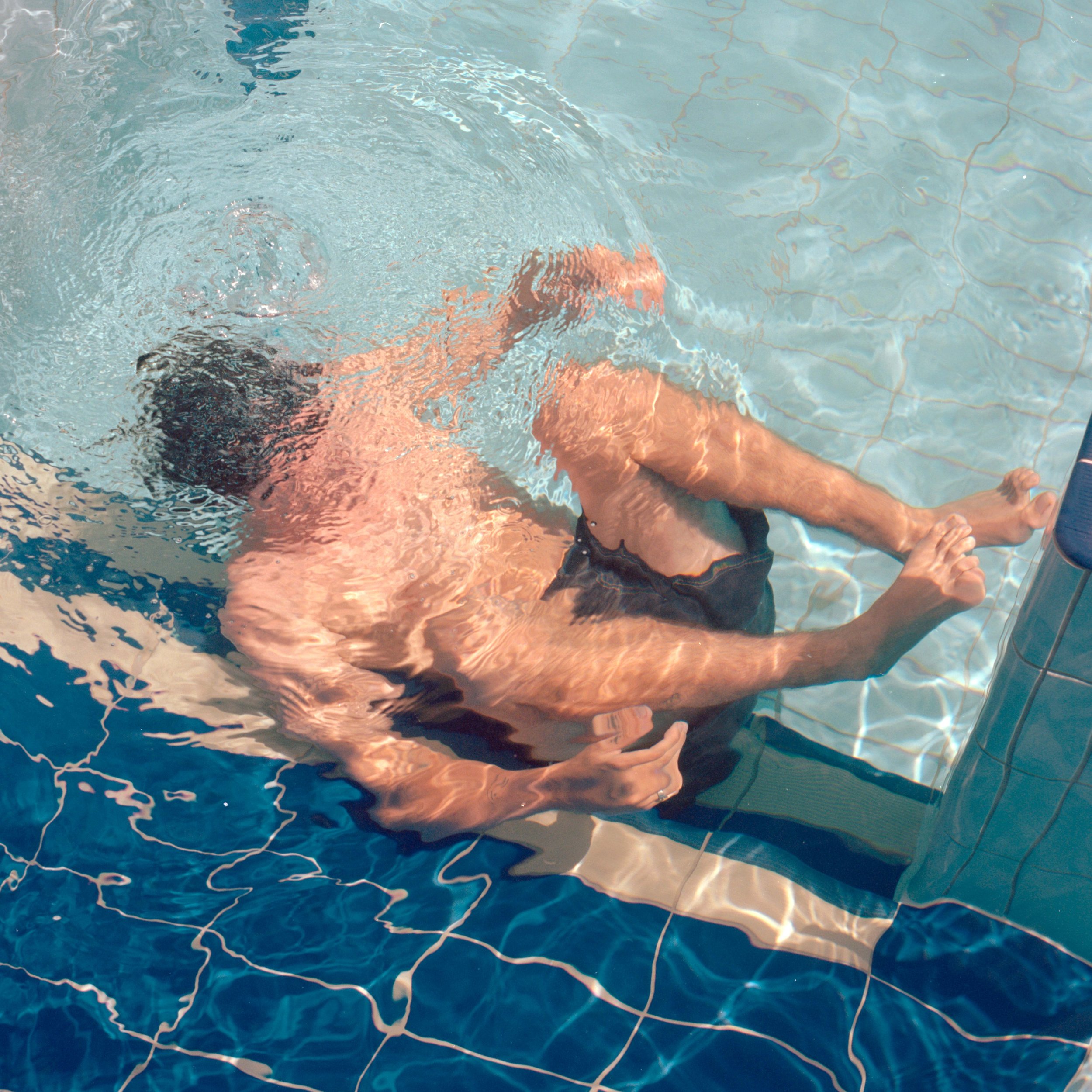
Thinking through political scenographies and unstable grounds, one might drift towards warmer seas and glimpse Aldo Rossi’s Teatro del Mondo approaching the horizon. The floating theatre, built for the inaugural Venice Architecture Biennale in 1980, offered a brief spatial reversal: a mobile architectural body that turned Venice into its performer. After its debut in the lagoon, it crossed the Adriatic to Dubrovnik, attaching itself for a moment to another shore before continuing its passage into dismantling. A Latvian children’s story, Dullais Dauka (Crazy Dauka), tells of a boy from a fishing village who becomes obsessed with reaching the horizon and one day rows out towards the line where water meets clouds. Dauka might have stepped aboard Rossi’s floating theatre.
The Baltics drift in a similar choreography, steered by Western currents and sharp winds, linked through infrastructural joints, yet exposed to the first splashes of the waves. In unsettled weather, the markers of safe passage can vanish, and what remains is the work of navigating a landscape that is always in motion, yet rarely allowed to appear adrift. Lately, planes in the Baltic airspace have reported that GPS is not working properly. But when in doubt, it is always a good idea to aim for the horizon.
++
The Blur of Via
Upon gaining independence from Soviet occupation in 1991, for the Baltic States, the float of geopolitical stability had to be steered westward, a sharp turn of one hundred and eighty degrees. The to-do list was long: NATO, EU, Euro, Schengen, some of the notable coordinates in the arena of international diplomacy. The Baltic Way had to be translated into entangled physical infrastructures: updating roads and cucumbers to standards set in Brussels, converting rail gauges from Soviet to Western European standard, opening up to the free market, and with that, some ghosts got through the door. Cowboy capitalism. Introducing real estate speculation into the communist logic of housing stock, launching private banks, some of which quickly went bankrupt or revealed themselves as scams, followed by the swift arrival of Swedish banks and chain supermarkets, plotting new national companies, one for gas, one for water, one for heating, one for air travel. Introducing such terms as ‘public–private partnership’ to the political bingo.
Perhaps it is productive to speak of this tidal turn through the machine of the projector. Projects encompass both logistical and visionary capacities. In the post-Soviet context, one has to project while also dealing with logistics. There is always a sense of urgency in catching up. What do you show on a projector while you are still figuring out the electricity provider? The screen flickers, it is a blur. As Estonian linguist Raili Marling writes, post-socialism is not a geographical concept but a temporal one. It positions Eastern Europeans as forever ‘lagging behind’ the West in a futile attempt to make up for the time spent under Soviet occupation. Our temporalities have not yet synchronised, and this tension, of projecting while also doing a project, keeps us slightly out of time.
In High School Musical 2, there is a moment when the main characters, friends from the same high school, are working summer jobs at a golf club near Albuquerque, New Mexico, to earn some money for college. Midway through the film, the job seems to have lost its spark, it is boring and hard to endure, and mornings start too early. The cast gathers in the kitchen and begins to dance with pots and pans in resentment of the summer employment. Troy (Zac Efron) takes the lead in the complicated zig-zag-snap-zig-zag-hands-up dance routine while singing the chorus:
We’ve got to work, work, to work this out
We’ll make things right, the sun will shine
If we work, work, there’ll be no doubt
We can still save the summer
If we work this out
Pay day! – the group sings together at the end
They go back to work afterwards. It is summer, and there is still romance to drift into, Troy and Gabriella, will-they, won’t-they, Troy and Gabriella forever. In the Baltics, shooting stars fly over lovers’ heads in August. A few meteors might even fall, and the crater they leave could be deep enough to swim butterfly.
++
Sweden
Where are you from?
Latvia
Litauen?
Lettonie
EU?
Mhm
Schengen?
Schengen yes
Where is it?
The Baltic States, Lithuania, Latvia, Estonia. Latvia in the middle [traces contour with a finger]
Not sure
The Baltic Sea?
Russia?
You know Sweden? Sweden is close by
Aaa Sweden! I know Sweden, yes, Norway, Denmark (…)
So now you know
I like Sweden
++
Vaporetto Pilgrims
You pay in cash? By card, please. Ah? Three euros? I did not make up the price. Do you need an invoice? Yes, for taxes. Boa neatly folds it into the transparent plastic folder marked with a post-it TAXES 2025. After hearing that Vilnius City would start electric boat cruises on the Neris River in summer 2025, Boa, anxiously turning 30, decided to spend the birthday on the water. But it is so slow, Boa, you could walk faster. Boa silently disagrees, and frankly sees high potential in the Vilnius waterway revitalisation project. Let me indulge, let me be slow, let me see Baltasis Tiltas from a frontal angle, let me think of Paris while in Vilnius.
Grandmother calls to wish well, and ends the call with life so short, my dear, passes in a second, gone. Boa sees a reel on instagram where Pope Francis is dying, mid-shot of his head turns into the zoomed-in bolded letters Live Passionately, his last words, the caption states. Thinking of the graves of grandfathers, fathers, aunts, and calculating the average dying age of lost relatives, Boa arrives at 62.4 for men and 78.1 for women. Is 30 kind of mid-life? Panic waves hit the lower left side of the lungs, in a single breathing spasm Boa takes out the invoice folder, finds the taxes post-it and writes TO DO with a gentle cloud bubble around. Passionate life, one line lower. It has to be ambitious yet still doable.
This year Boa will find love and kiss at the Eiffel Tower or at least under Baltasis Tiltas with that year-long handsome friend having googled ‘can both sides feel the chemistry’ after every meeting. Boa will make the move and touch their hair before leaning in. Boa will not go in too strong with the tongue as with Momo last year. Boa is curious to start an open relationship. Boa notes, read more on relationship anarchy. And Boa will definitely try to make a short documentary film to submit to Visions du Réel. Who knows, maybe even Cannes or Venice. It could be really good. Boa writes down Oscars 2029, with some time to spare.
The fleet of Neris River cruises features four catamaran-style boats named through a public vote. The chosen names are Rytas (Morning), Lašiša (Salmon), Geležinis Vilkas (Iron Wolf) and Smilga (Bentgrass). Boa thinks of the grounding energy of the strong-willed-named smooth boat touching the long seaweed. Boa thinks of the intense chemistry with the friend, notes down act on energies more! in the list, next to start a successful enterprise for nomadic work and Bali / NYC 2026 (but NYC could be nicely combined with the Oscars in 2029, note to self: flexible). In the rush of the dream planning session, the boat drifts away from the last stop.
The Iron Wolf pauses for a second and switches to gas. The boat runs at the speed of stars. The day could have turned into a week, no way of knowing. Wind on red cheeks hurts like a kitchen knife. Boa moves inside. A hand-drawn seating chart has turned into a TV. Big Ben canvas on the wall. Next stop is London. Boa is tired of travelling around. Do not open the window! The steward scratches Boa’s back with a touch of flirt. Outside is a blur. Then after some days, having eaten herring in tomato sauce for the last two to thirteen nights, all the dead arrive led by Gediminas from the grave. Boa disappears into the hot tub, closes eyes, and thinks of Brodsky in Venice in January. [And I vowed to myself that should I ever get out of my empire, should this eel ever escape the Baltic, the first thing I would do would be to come to Venice, rent a room on the ground floor of some palazzo so that the waves raised by passing boats would splash against my window.] I am vaporetto 1, Sant’Elena to Lido. I am vaporetto 1 and MOSE protects from the flood.
Mentally teleporting back to Kaunas, the next stop, Boa sees RAKETA, the river-to-sea vessel travelling from Kaunas to Nida, sailing like an older seal near Bornholm, eyeing for a sunny spot. Boa has been dying to try RAKETA, much more than the Iron Wolf to be honest, if not for the dynamic pricing. Live passionately. Boa takes off the white helmet and the bathrobe and the ballet slippers and the glittery belt and the cap and the purple speedos and the bikini top, and jumps off towards the speedy liner RAKETA, headed towards Curonian Lagoon. A hard landing but enough strength left for Boa to chant
Take me to Venice, RAKETA!
Take me to Venice!
++
From Jonas Mekas diaries:
May 26, 1963
I am thinking now about that morning, today, two weeks later, closed in a thick fog of the Atlantic. I can still hear the ship calling, and each time I think the sun perhaps broke out, perhaps, & I look out & I see nothing but the thick fog, and the wind gusts throw small rain showers into my tired eyes.
June 2, 1963
The Lithuanians in their pantheist days kept an eternal fire, guarded by vaidilutes (young virgins).
++
The Law of Attraction
Lauren Berlant’s notion of cruel optimism describes a relation in which something you desire becomes an obstacle to your own flourishing. This object of desire might be food, a form of love, a fantasy of the good life, or a political project. It might also be something more modest, such as a new habit promising a better way of being. Berlant notes that such attachments can turn toxic.
This raises the question of attachment between two semi-technical beings when one exists only as an imaginary, unfinished, or on-paper entity, and the other functions as a real artefact that will eventually connect to that imagined form. What kind of attachment emerges between Zaha Hadid Architects and the city of Vilnius? Between the Sydney Opera House and the Brandenburg Gate? There may be an umbilical cord between things and places, and on a higher level, even a law of attraction: you attract what you project. In 2001, during the closing concert of the Song Festival, former Latvian president Vaira Vīķe-Freiberga, a doctor of psychology, turned her speech into a guided manifestation session. Standing on the conductor’s podium, she spoke while the audience repeated: We are strong. We are great. We are productive. We are beautiful. We know what we want. And what we want, we can do. And what we can, we do.
On the northern edge of Šiauliai, the Hill of Crosses offers another lesson in persistence. Under Soviet rule, religion was banned and the hill repeatedly destroyed—first bulldozed and burned in April 1961, then razed four more times. Each time, locals returned under cover of night to rebuild it. The site grew through repeated acts of return, gaining density in the face of suppression. Even monuments can grow from debris, if you really want them to.
++
The Center of Europe
Based on calculations by the French National Geographic Institute, the geographical center of Europe is near Purnuškės, Lithuania.
In short – description from Vilnius tourism office
The Geographical Centre of Europe is a great place for travel enthusiasts because they can get a certificate declaring they have reached the centre of Europe.
Paula Veidenbauma (b. 1997, Riga) is an artist based in Vienna, Austria. With a background in Urban Studies and Film, she works within intersections of architecture, visual arts, and theatre. Her practice engages with real estate politics and aesthetics, project(ed) dramaturgies, limits of flexibility, and expanded notions of renovation.